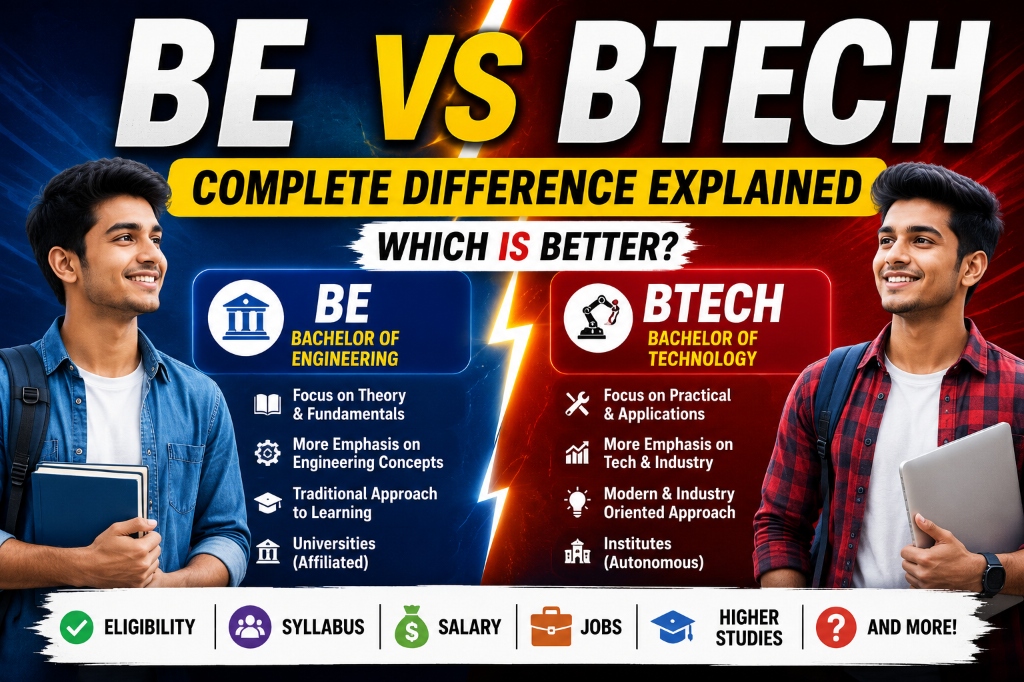
⚡ TL;DR:
Both BE and BTech are highly valued four-year undergraduate engineering degrees recognized by AICTE. BE leans slightly more towards theoretical foundations and scientific principles, while BTech emphasizes practical applications and modern industry tools. In 2026, recruiters treat both degrees equally, with salaries and placements depending entirely on your coding skills, practical projects, and internships.
Subscribe to Our YouTube Channel!
Get step-by-step guidance videos, project reports, and ppt templates for final year submissions.
If you're a diploma or 12th science student planning to pursue engineering, one of the most common questions you will face is: "What is the difference between BE and BTech?"
Many students mistakenly think they are completely different degrees, while others believe one holds superior placement value. The truth is that both degrees have almost identical recognition in India, but there are some important differences in curriculum focus, teaching methodology, practical exposure, and university structures.
In this guide, we'll break down the comparisons and clear up the common myths in simple language.
📚 What is BE (Bachelor of Engineering)?
BE (Bachelor of Engineering) is an undergraduate engineering program that mainly focuses on core engineering concepts, theoretical foundations, mathematical formulas, and scientific principles.
Students typically learn:
- Engineering fundamentals and theories.
- Advanced mathematical models and derivations.
- Scientific problem solving.
- System design and research concepts.
BE programs traditionally emphasize understanding how engineering laws and mathematical models work before applying them in fields.
💻 What is BTech (Bachelor of Technology)?
BTech (Bachelor of Technology) is also a four-year undergraduate engineering degree. Unlike BE, BTech focuses heavily on application-based studies, modern industry technologies, and practical implementations.
BTech programs focus on:
- Practical learning and application of concepts.
- Advanced laboratory work and technical simulations.
- Live industry projects and case studies.
- Internship experience and hands-on tool operations.
BTech students spend more time building real-world solutions and using modern technologies rather than focusing solely on scientific derivations.
🏛️ Autonomous Institutes (BTech) vs. Affiliated Universities (BE)
One of the most practical differences between these two degrees lies in the administrative and academic structure of the offering colleges:
- Affiliated Universities (BE): BE degrees are usually offered by engineering colleges affiliated with a centralized state university (such as Mumbai University, SPPU, or Nagpur University). The university designs a standardized syllabus, organizes common examinations, and conducts central paper evaluations. Syllabus revisions in affiliated systems occur less frequently due to the administrative scale of coordinating hundreds of colleges.
- Autonomous Institutes & Deemed Universities (BTech): BTech degrees are typically awarded by autonomous engineering colleges (like COEP Tech, VJTI) or deemed/private universities (like MIT-WPU, Symbiosis). These colleges design their own academic programs and evaluate students internally. This autonomy enables them to rapidly revise curricula, introduce trending subjects (like Prompt Engineering or Blockchain development), and structure dynamic credit outlines.
📊 BE vs BTech Side-by-Side Comparison
| Feature | BE | BTech |
|---|---|---|
| Full Form | Bachelor of Engineering | Bachelor of Technology |
| Duration | 4 Years (8 Semesters) | 4 Years (8 Semesters) |
| AICTE Approved | ✅ Yes | ✅ Yes |
| Practical Learning | Moderate | High |
| Theory Focus | More | Less |
| Industry Exposure | Moderate | High |
| Internship Focus | Medium | High |
| Placement Opportunities | Excellent | Excellent |
| Government Jobs | Eligible | Eligible |
🤔 Which Degree is Better in 2026?
The simple answer is: Neither degree is inherently better than the other.
Corporations generally treat BE and BTech graduates equally. During campus placements and off-campus recruitment, interviewers focus heavily on your skills, project quality, and coding abilities. To give your resume a major boost, check out our comprehensive guide on the Top 100 Engineering Project Ideas to choose a trending final year Capstone project.
🌐 The Washington Accord & International Recognition
For students who plan to study abroad or seek jobs in global corporations, degree recognition is highly important.
India is a permanent member of the Washington Accord through the National Board of Accreditation (NBA). Under this accord, engineering degrees (both BE and BTech) awarded by NBA-accredited courses/institutes in India are globally recognized and treated as equivalent to degrees from other signatory nations. This means that whether your degree says BE or BTech, it will be fully accepted for postgraduate applications (MS, PhD) and professional engineering registrations in countries like the USA, UK, Canada, Australia, Singapore, and Japan.
💰 BE vs BTech Salary
There is absolutely no salary difference based solely on whether your degree is titled BE or BTech. Companies structure salaries based on technical roles and your skillset.
| Experience | Average Salary Range |
|---|---|
| Fresher Graduate | ₹3.0 – ₹8.0 LPA |
| 2 to 5 Years | ₹6.0 – ₹15.0 LPA |
| 5 to 10 Years | ₹12.0 – ₹30.0 LPA |
Top tech giants—including Google, Microsoft, Amazon, TCS, Infosys, Accenture, IBM, and Deloitte—hire both BE and BTech graduates under identical job profiles.
📝 Choice Based Credit System (CBCS) & AICTE Guidelines
Both degrees follow the strict guidelines set by the All India Council for Technical Education (AICTE) and use the Choice Based Credit System (CBCS).
Under the AICTE curriculum framework, a student must complete a minimum of 160 credits over four years (or approximately 120 credits for Direct Second Year DSE admissions after a diploma) to earn an undergraduate engineering degree. Both degrees require standard semester workloads, mandatory internships, continuous laboratory evaluations, and a final-year Capstone project, making them academically equal.
🎓 BE vs BTech After Polytechnic Diploma
If you are an MSBTE polytechnic diploma student taking Direct Second Year (DSE) admission, you will usually join:
- BE programs in traditional state universities like Savitribai Phule Pune University. If you want to check exam updates, refer to the SPPU Engineering Results 2026 portal.
- BTech programs in autonomous institutes and private universities such as COEP Technological University, MIT-WPU, and others.
For detailed registration steps and cut-off rounds, read our comprehensive Direct Second Year (DSE) Admission Guide.
⚡ Common Myths & Misconceptions
Myth 1: BTech is better than BE.
❌ False. Both are recognized equally by the Government of India, AICTE, and international bodies for employment.
Myth 2: BE students cannot work in software companies.
❌ False. Software firms care about your coding logic and algorithms, not the degree title.
Myth 3: Government jobs prefer BE over BTech.
❌ False. UPSC, GATE, ISRO, DRDO, and PSU recruitments accept both degrees under the same engineering categories.
🔑 Final Verdict: How to Choose?
When choosing between engineering colleges, prioritize **college infrastructure, placement record, faculty experience, internship avenues, and branch specialization** over whether they award a BE or BTech degree. Ultimately, your career progression in engineering is determined by your technical competence and continuous learning.
Frequently Asked Questions (FAQ)
Q: Is BE equal to BTech?
A: Yes. Both are undergraduate engineering degrees recognized by AICTE and accepted by employers and universities.
Q: Which degree is better for software engineering?
A: Both are equally suitable. Your programming skills, projects, and internship experience matter far more.
Q: Is BE valid abroad?
A: Yes. BE is recognized internationally for higher studies and employment, subject to the destination country's evaluation process.
Q: Can BE students write GATE?
A: Yes. Both BE and BTech graduates are eligible for GATE.
Q: Is there any salary difference between BE and BTech?
A: No. Salaries depend on your skills, college, experience, and employer—not the degree title.