Subscribe to Our YouTube Channel!
Get the latest MSBTE updates, video lectures, and exam tips directly on YouTube.
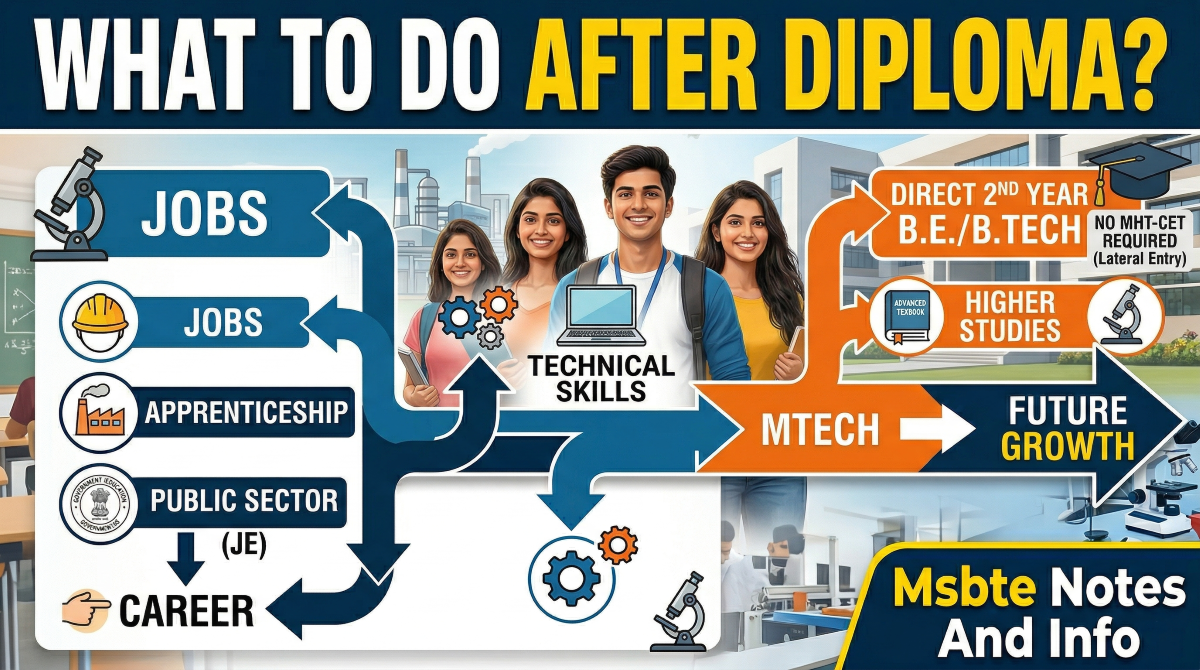
In Maharashtra, the "Diploma to Degree" culture is incredibly strong, but it is certainly not the only path available. From lateral entry into top engineering colleges to high-paying government jobs, polytechnic graduates have a wide array of opportunities. (If you are still in school, check out our guide on what to do after 10th).
Decision Matrix: Degree vs Job
The DSE Roadmap: Diploma to Degree
Step 1: Final Year Diploma
Score well in 5th and 6th sem (Admission is based on this %).
Step 2: CAP Round Registration
Apply via State Common Entrance Test Cell portal.
Step 3: Allotment & Reporting
Secure seat in B.E./B.Tech based on your merit-list rank.
Step 4: Graduate in 3 Years
You join directly in 2nd year and graduate with others.
Choose Your Specialization Path
Technical Core
Deep dive into Engineering with B.E./B.Tech.
- • Direct 2nd Year Entry
- • Specialise in AI, Robotics, etc.
- • High Corporate Demand
Govt Services
Stability with SSC JE, RRB, and PWD jobs.
- • Junior Engineer Positions
- • Pension & Added Benefits
- • Competitive Exam Focus
Self-Employment
Start your own consultancy or service firm.
- • MSME Registrations
- • PWD Contractor Licences
- • Financial Independence
1. The Most Popular Path: Direct Second Year B.E. / B.Tech
In Maharashtra, a large percentage of diploma holders choose to pursue a degree. The state government facilitates this through the Direct Second Year Engineering (DSE) lateral entry system.
- How it Works: You skip the first year of engineering and join directly in the second year (third semester).
- The Admission Process: Admission is based on your final year diploma percentage (marks obtained in the 5th and 6th semesters). In Maharashtra, this is managed by the State Common Entrance Test Cell.
- Why choose this? You earn a full degree in just 3 additional years, graduating at the same time as those who took the 11th/12th route, but with much stronger practical skills.
2. Professional Certifications & Short-Term Courses
Short-term professional courses can bridge the gap between college theory and industry requirements, making you highly "job-ready."
- For Computer/IT: Full-stack development, Cyber Security, or Data Science.
- For Mechanical/Civil: CAD/CAM, Revit, Primavera, or HVAC design.
- For Electrical/Electronics: PLC/SCADA, Embedded Systems, or Robotics.
3. Entering the Workforce
A diploma makes you a "Technician" or "Junior Engineer," roles that are vital to the industry.
- Public Sector (Government Jobs): Appear for exams like SSC JE, RRB JE, or positions in departments like MAHADISCOM, MSRTC, or PWD.
- Private Sector: Firms like Tata Motors, L&T, and Reliance actively recruit diploma holders for supervisory or technical roles.
- Apprenticeship: Join the National Apprenticeship Training Scheme (NATS) for one year of paid on-the-job training.
4. Competitive Exams After Diploma
While some entry-level technical exams are accessible, major administrative exams like MPSC or UPSC require a completed degree (B.E./B.Tech) first.
5. Entrepreneurship
With practical knowledge, many students start their own ventures, such as electrical contracting, web development agencies, or small-scale fabrication units.
Summary Table: Which Path to Choose?
| Goal | Best Option | Duration |
|---|---|---|
| Higher Salary/Management | B.E. / B.Tech (Direct 2nd Year) | 3 Years |
| Quick Financial Independence | Private Job or Apprenticeship | Immediate |
| Job Security | Government Junior Engineer Exams | 6-12 months prep |
| Niche Expertise | Technical Certifications | 3-6 Months |
Key Advice for Students
- Don't Rush: If your marks are good, getting a degree often pays off in the long run through faster promotions.
- Stay Updated: Keep an eye on the official DTE Maharashtra website for lateral entry admission schedules.
- Build a Portfolio: Document your final year projects—they are your best "proof of skill."
Frequently Asked Questions (FAQs)
Join Our Student Community!
Get instant notifications about admissions, exam dates, and study materials. Join our WhatsApp group today!
Join WhatsApp CommunityFrequently Asked Questions
Q: Can I do B.E./B.Tech after Diploma in distance mode?
A: While some universities offer it, for professional engineering roles in India, a **Regular (Full-time)** degree via DSE is highly recommended and recognized by AICTE.
Q: Is MHT-CET required for Direct Second Year admission?
A: **No.** In Maharashtra, DSE (Direct Second Year) admission is strictly based on your **Final Year Diploma percentage**.
Q: Can I change my branch in the Degree?
A: Partially yes. Some branches are compatible (e.g., IT and Computer). However, switching from Civil to Computer is usually not permitted in DSE.